Wednesday, November 16, 2005

Arachnophilia

ArachnophiliaArachnophilia is a Java based text and HTML editor. That means it will run on any computer (Mac, Linux, Windows ), that has Java installed.
It takes a while to get used to it, but it is worthwhile investigating its features:
The application handles frames, CGI, Perl, C++, Java, and JavaScript development.
  • The table wizard is fantastic, specially when importing and converting text, RTF documents, tables, and outlines.
  • It has a built-in FTP client, that allows utomatic uploading of changed files.
  • It features keyboard macros that can include system commands or other macros to make your life easier and more productive (which is what computing is supposed to be about.
ArachnophiliaArachnophilia is CareWare.
That means that the only thing the author asks you in return for using his software is that you:
"stop whining about how hard your life is for an hour, a day, a week, your choice, and you will have earned your copy of Arachnophilia.
Say encouraging words to young people, make them feel welcome on the planet Earth (many do not).
Show by example that we don't need all we have in order to be happy and productive".

We think we've got the idea and we are going to put it into practice. :-)
I never saw a wild thing
Sorry for itself.
A small bird will drop frozen dead
From a bough
Without ever having felt sorry for itself.

D. H. Lawrence
Gadget Inspector

Monday, November 14, 2005

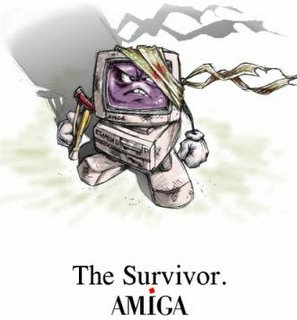
The Curse of the Amiga

Is the Amiga Dead, Yet?
Not Yet.

Is it cursed?
No doubt.

Even me, as I was writing this post, had Firefox crashed for the first time ever and lost about an hour's work. Previously I had tried to post from Elicit and Zoundry with similar results. In more than 3 years blogging I had NEVER experienced anythithing even remotely similar. When I restarted, my right button search function had disappeared, and all that put together have made this post the one that has taken more effort to create by far. But, you see, I am an obstinate bastard, specially when it comes to something I've spent so many years working and playing with (rather the other way around) and that is so close to my heart as the Amiga.

I have been a fanatic user of the Amiga from 1991 until the turn of the millenium, and I still think it was the best machine mankind has ever created. What has happened to this computer is a real techno-tragedy and I am sure it has altered the course of History, and not for the Good.

I haven't tried the latest hardware and software, but here is an excellent review of Jeremy Reimer, who bought an AmigaOne Micro with OS4 on November 2004:

The Micro-AmigaOne and Amiga OS4 Developer Prerelease
Jay Miner started the Amiga Inc. computer company in 1982 before Commodore bought them out.
The Amiga computer was first commercialized released in 1985 by Commodore, that eventually went bankrupt in April 1994.
Commodore was bought at liquidation by Escom AG, who had no real interest in the Amiga. Escom itself went bankrupt a few years later, and the Amiga was briefly bought out by set-top manufacturer VISCorp, before they too filed for liquidation.
Its new owner was Gateway Computers, who were only interested in Commodore's old patent portfolio. When it became increasingly clear that Gateway was never going to do anything with the Amiga, a consortium of investors calling themselves Amino Development bought out the rights to the Amiga hardware and OS in 1999.
The new AmigaOne motherboards were first released in 2002, but there was no OS to go with them, so they shipped with Debian PPC Linux. After an agonizing 18-month wait, the first Developer Prerelease CD of OS4 was shipped to AmigaOne owners worldwide.
AmigaOne OS4
OS4 boots remarkably quickly. From a cold boot, including waiting for power up, BIOS messages, straight to a usable desktop took slightly over 30 seconds. A "warm boot," which bypasses the BIOS startup and merely reloads the operating system, takes slightly over 10 seconds.
One feature of the original custom Amiga graphics chips was that you could "pull" down screens with the mouse to see screens that were behind them. This feature, called "draggable screens," was never duplicated by any graphics card manufacturer since, so sadly it is not available on the AmigaOne.
A cold boot, including power up, BIOS messages, takes less than what it takes you to get accomodated in your chair. Compare that to any Windows/Mac OS start-up. They usually give me enough time to go and make coffee (Mac OSX is not that sluggish, to be honest).
I am sorry to hear that there is no "draggable screens".
Another cool feature was the abilty of clicking on several menu items at once (holding right-side button and clicking with the left), and get the commands batch-processed at once.

Many people, upon reading the hardware specs of the Micro Amiga One, will feel that the performance (800MHz PowerPC 750FX, SDR RAM) is far below modern gear. This is true to a certain extent, but it does not give the whole picture. AmigaOS was originally written for a 7.14 MHz 68000, and the last Classic version released by Commodore, 3.1, was optimized for a 12 MHz 68020 platform. According to Hyperion, over 90% of the OS code has been converted from 68k to PPC, and the only code yet to be translated (serial port code, AREXX macro routines), does not typically impact on performance.
Because the OS is so small (About 60MB on disk for a complete install), it fits very nicely in 256MB of RAM, with room for several applications, most of which have a similarly small memory footprint. This means that you can run the OS and multitask between several applications without ever swapping to the disk.

I have created and run multimedia presentations for TV stations on as little as an Amiga 500, 1Mb RAM, 720 Kb floppy, no Hard Drive. Gosh, I miss Scala so much...

In speeches around the world, Alan Redhouse of Eyetech always opens by saying that everyone always asks them: "Why are you doing this?" And the answer he gives, with a smile, is "We don't know!" There is an infectious enthusiasm among Amiga users...

Infectious enthusiasm defines the feeling of Amiga users at that time.
As of today, if you visit Amiga's Headquarters (http://www.amiga.com/) you'll be presented with the latest technology in ... Jackpots!!!?
It has broken my heart.

Better visit this one: http://www.amiga.org/

Is there a future for the Amiga?
Some people seem to think so:
http://www.amigaworld.net/
http://www.amitopia.no/

Jeremy Reimer has a website full of undiscovered gems at:
http://www.pegasus3d.com/jer_main.html
where among other things he promotes StudlyOS, as the Only Operating System You Will Ever Need.
I wish I had the time to try it out.
I liked the Amigan comment on it, though:

"StudlyOS sucks!!!1111 Y00 think itz c00l but your rong!!!!!11111 I Cant run it on my Am1ga so what yoos is it????/ My Am1ga beats yor peecee anyday!!!!!! !!!11111111 Peecee even with StudlyOS cant beet Amiga because Amiga rules!!!! Amiga iz better because it is Amiga!!!1111 Nothing else is Amiga!!!11111" - B1FF


The Amiga Boing Ball is a mythical object in the computer industry. It was created as an example of the machines ability. The demo showed a red and white ball bouncing around the screen and interacting with the environment- it bounced off the walls, spun, while multitasking in the background.


That demo helped sell a million Amigas displaying smooth animation in full colour in a time when other computers were only just managing colour display.


scala


Technorati : amiga

Sunday, November 13, 2005

UNDERSTANDING NANOTECHNOLOGY

Scientific American's book "UNDERSTANDING NANOTECHNOLOGY" offers an insight into a new technology with applications in computing, science, medicine, communications, home appliances, and almost any other aspect of today's World.

http://www.sciam.com


Saturday, November 12, 2005

Sailing Shop


Do you like sailing?
We certainly do.


Nothing to do with Computers?
Sailing Software

The Next Frontier

Outlines have been a popular way to organize information on computers for a long time. While the history of outlining software is unclear, a rough timeline is possible.

Probably the first outliner was developed by Doug Engelbart, as part of the Augment system in the 1960s.

Living Videotext, 1981-87, developed several popular outliners for personal computers. They are archived on a UserLand website, outliners.com.

Dave Winer was the first programmer to bring outlining to the desktop for non-programming use.
ThinkTank and MORE were some of his killer applications in their own space, leading to widespread use of the outlining phylosophy.

He wrote or contributed to a number of relevant specifications, including SOAP, XML-RPC, RSS and OPML.


SOAP Simple Object Access Protocol to let applications exchange information over HTTP.
XML-RPC A remote procedure call protocol encoded in XML. It became what is now SOAP
OPMLOutline Processor Markup Language is an XML format for outlines
RSS A family of XML file formats for Web syndication

XML 1.0, the format that OPML is based on, is a recommendation of the W3C.

Frontier, first shipped in 1992, is built around outlining. The text, menu and script editors in Frontier are outliners, as is the object database browser.
A high performance Web content management, object database, system-level and Internet scripting environment, including source code editing and debugging.
Dave Winner explained the rationale for releasing Frontier as open source on Scripting News on May 17, 2004.


Frontier Kernel
Developing the Frontier kernel in the 21st Century


Wednesday, November 09, 2005

Blog Writing Software First 100 Hours Test

Over the past month or so we have tried several client-based Blog Writers.

We've looked for simplicity, funcionality, tools for associates, tags and submission tools and last but not least, price.

The Magikomputer Prize in Blog Writing Software goes to :

Zoundry: Simple and elegant Blog Writer and yet very powerful. It is by far the Blog Writer we've liked the most.
Competitors are ecto (it has a Mac version) and Elicit (very complete but a bit unstable).
Blogjet is way behind in features and w.bloggar while being free, it hasn't been updated for a while, although w.bloggar is not dead (neither am I ! -says Marcelo Cabral).

The Prize consists of favourable reviews along this blog. As long the software lives up to it, that is.

Technorati : , , , , ,

Tuesday, November 08, 2005

Elicit Try-Out

Just giving Elicit a try.


Elicit


Awesome, to be honest.


But buggy when trying to edit an image src through the Properties Grid ... :-(


http://wwww.website.com/

Monday, November 07, 2005

Uncreative Commons

Uncreative Commons


uncreative commons

Feel Free to Laugh at Copyright Holders

http://supr.c.ilio.us/un/hu-lb-dr/01/


Technorati : ,

Deshaucio Oficina MagiKomputer

MagiKomputer ha sido condenado a desalojar el l Ventorro de Las Corchas antes del 22 de Noviembre.

Hay 5 días para apelar la Sentencia.

Saturday, November 05, 2005

The Zoundry Blog Writer

The Zoundry Blog Writer, A Blogger's Dream Come True

I have been looking for a program like this one for a while.
There are a few around similar, but not Windows-based and free.

Easy as 1-2-3:
1- Write a product review with Zoundry Blog Writer.
2- Link to the product with a few simple clicks.
3- Post it to your blog.

Lawrence C. Lee, President of Zoundry LLC: "An easier point-and-click solution."

The blogger earns a commission through the Zoundry Service whenever someone reads his weblog, at , or via an RSS feed, and clicks through to purchase. Zoundry keeps a percentage of the rewards as a transaction fee.

The service is only available for the U.S. at the present time, but is definitely worth just using the free Zoundry Blog Writer.


Developing Feeds with RSS and AtomDeveloping Feeds with RSS and Atom

Spain's affiliate programs

I've been asked wether online merchants in Spain have affiliate programs.

My research concludes that affiliates programs in Spain have yet to develop into the kind of business that you can see in countries like the U.S. That applies to Latin American countries as well.

Latest data for Spain and South America look promising though.

Below are the main contenders:

Trade Doubler
TradeDoubler: Proveedor europeo en soluciones de marketing online y ventas

netfilia
netfilia: Empresa proveedora de servicios de marketing de resultados y programas de afiliación en Internet.

PubliSurf
Publisurf.com tiene un directorio de programas de afiliación con propuestas de marketing y comercio electrónico.


The Super Affiliate Handbook: How I Made $436,797 in One Year Selling Other People's Stuff OnlineThe Super Affiliate Handbook: How I Made $436,797 in One Year Selling Other People's Stuff Online

Technorati :

400,000 Windows computers hacked for profit

If a 20-year-old can do this on his own, just imagine what a large-scale criminal spamming scheme is probably doing right now. Scary, isn't it?


FBI agents arrested a 20-year-old Los Angeles man (or rather, boy) Thursday on charges that he cracked some 400,000 Windows machines and covertly installed pop-up-generating adware on them, in a scheme that allegedly brought in $60,000 in ill-gotten profits.

He began in November 2004, when he used a botnet of 26,975 computers to make about $4,000 through Gammacash affiliate program, and another 8,744 compromised hosts to pull in $1,300 from LOUDcash. He continued cashing checks in the low four figures every few weeks, ultimately earning $58,357.86 from the scheme, according to the indictment.


More...
http://www.wired.com/news/technology/0,1282,69480,00.html?tw=wn_2techhead


2003 Guide to Computer and Internet Crimes and Cybercrime: Hacking, Intellectual Property Crimes, Policy, Cases, Guidance, Laws, Documents, Web Crimes, Targets (Core Federal Information Series CD-ROM)2003 Guide to Computer and Internet Crimes and Cybercrime: Hacking, Intellectual Property Crimes, Policy, Cases, Guidance, Laws, Documents, Web Crimes, Targets (Core Federal Information Series CD-ROM)

Technorati : ,

Friday, November 04, 2005

TechnoServe

TechnoServe

TechnoServe es una organización sin ánimo de lucro con más de 36 años de servicio en el área de desenvolvimiento económico en África y Latino América.

Tienen como misión es dar servicio a las zonas pobres rurales de los países en desarrollo para crear negocios que produzcan beneficios, oportunidades y crecimiento económico para las familias, comunidades y países más desfavorecidos.

Technorati :

La Parana

Amazon Pages service will allow individual book pages to be purchased

Amazon is launching two new services:
The Amazon Pages service plans to let customers to buy portions of a book (even just one page) for online viewing.
The Amazon Upgrade service will offer full online access when a traditional text is purchased.
Both services are expected to begin in 2006.
The cost for most books would be a few cents per page, although readers would likely be charged more for specialized reference works.
Under Amazon Upgrade, anybody purchasing a paper book will get instant online access to it, plus they will receive a physical copy of the book.
"We see this as a win-win-win situation: good for readers, good for publishers and good for authors," commented Amazon CEO Jeff Bezos.
The new programs are an extension of Amazon's "Search Inside the Book", which lets users browse a book's contents for free.
Amazon Shorts, another program, offers brief, original fiction and nonfiction for 49 cents each.
The Amazon announcement came on the same day that Google began serving up contents from books and government documents from five major american libraries.


Technorati :

Libraries on-line

Google plans scan the entire contents of several University libraries in November and make what it calls "snippets" of the works available online, free of charge.
Libraries targeted are those of Harvard, Stanford, the University of Michigan, the University of Oxford, and The New York Public Library

Web 2.0

Web 2.0, is an architecture of participation that links between web applications, blog publishing and self-service advertising.
This architecture is based on social software where users generate content, and an open programming interface.

Blogs democratized publishing, now "tags" could be considered to democratize information architecture. What's behind this? Are powerful tools in the hands of millions really better than well-trained experts?
http://www.kottke.org/04/10/design-for-web-20

RMM


I created this post for the whole purpose of uploading a new photo in my profile.
Man, do I hate Picassa.
It would have been easier to just make a new regular post with inserted pic and just copy the location.
I know it's just me, dumb moron who doesn't understand the software, neither have the time to explore the help.
Posted by Picasa

Tuesday, November 01, 2005

Blogs Al Ataque

"Los Blogs son el mayor regalo que puede hacerse a una marabunta linchadora a la que se les llena la boca de libertad, pero solo escupen mentiras, difamaciones e injurias. Sus mejores aliados en esta "Cruzada" son Google y Yahoo ..."